The evidence for advanced lost civilisations is geological, astronomical, and architectural. Hancock, Schoch, and Carlson have built a rigorous scientific case. Here is the complete archive.
The Physical Evidence for Lost Civilisations
Seismically damaged ancient sites, astronomical alignments predating history, and underwater ruins — the physical case is overwhelming.
Robert Schoch — Sphinx Water Erosion: 12,000 Years Old
Randall Carlson — Younger Dryas Impact & Civilisation Wipe
Dolores Cannon — QHHT: Past Lives in Atlantis
Law of One — Ra on Atlantis & Lemurian History
The Civilisations That Were Seeded
According to the Ra Material, Alex Collier, and Dolores Cannon, Atlantis and Lemuria were ET-assisted civilisations — and their destruction was engineered.
Alex Collier — Andromedan Account of Atlantis
Bob Dean — ET Legacy in Ancient Civilisations
Michael Salla — ET Role in Ancient Earth History
Jacques Vallée — Ancient Contact & Modern Phenomenon
The Mechanism of Civilisation Destruction
Randall Carlson's geological research proves a cosmic impact 12,800 years ago wiped out a global civilisation — and may have been the origin of the flood myths.
Diana Pasulka — Ancient Religion as ET Legacy
Avi Loeb — Cosmic Impacts & Civilisation Vulnerability
Garry Nolan — Anomalous Evidence Through Deep Time
Nolan — Ancient Artefacts with Off-World Signatures
Where Archaeology & Disclosure Converge
The 2023 Congressional testimony about non-human craft recovery connects directly to the ancient civilisation question.
Congressional Hearing — Long-Term ET Presence
Kevin Knuth — Physics of Ancient ET Technology
Greer — Witnesses on ET Presence Through History
Sirius Documentary — Ancient Evidence Cases
The conventional history of human civilisation begins in Sumer, approximately 5,500 years ago, with the sudden emergence of writing, law, agriculture, astronomy, and complex urban organisation. Before that, the story goes, humans lived as hunter-gatherers, scratching at the earth and moving with the seasons. But there is another history — older, stranger, and far more complex — that conventional archaeology cannot fully account for.
Across the world, in cultures separated by oceans and millennia, the same stories resurface: a great civilisation that existed before the flood, advanced in knowledge and power, that fell through hubris, catastrophe, or both. Atlantis. Lemuria. The antediluvian world of the Sumerian texts. The pre-dynastic Egyptian culture that built the Sphinx before the pharaohs arrived. These are not merely myths. They are cultural memories — preserved in traditions, embedded in architecture, encoded in astronomical alignments, waiting to be read by those willing to look.
The evidence takes multiple forms. Physical anomalies like the Richat Structure in Mauritania (proposed as Atlantis by some researchers), the water erosion patterns on the Sphinx (suggesting it predates the dynastic period by thousands of years, according to geologist Robert Schoch), and the extraordinary precision of megalithic construction at sites from Göbekli Tepe to Sacsayhuamán to the Great Pyramid — all of these demand explanations that orthodox archaeology struggles to provide.
Literary evidence comes from Plato's Timaeus and Critias, the earliest detailed written account of Atlantis, attributed by Plato to Egyptian priests who told Solon that Athens had once defeated the Atlantean empire 9,000 years before his time. Edgar Cayce, in over 700 Akashic readings between 1923 and 1944, described Atlantis in extraordinary detail: its technology (crystals, flying craft, energy systems), its spiritual culture, its fall through the misuse of power, and the migration of Atlantean survivors to Egypt, the Yucatan, and elsewhere.
Rudolf Steiner accessed the same territory through trained clairvoyance, describing a "root race" of early humans in Atlantean and Lemurian times who were quite different in consciousness and physicality from modern humans — more etheric, more connected to the natural world, less individuated. His accounts in Cosmic Memory predate Cayce's readings and offer independent corroboration of key themes.
The Theosophical tradition, through Blavatsky's The Secret Doctrine, places Lemuria and Atlantis within a vast scheme of "root races" — each the dominant humanity of a geological age. Lemuria is placed in the Pacific/Indian Ocean region; Atlantis in the Atlantic. Both were said to have been destroyed through a combination of spiritual failure and natural catastrophe — pole shifts, floods, sinking continents.
What is striking is the convergence: independent sources — channeled, clairvoyant, philosophical, and now geological — pointing toward the same conclusion. There were advanced human civilisations before the ones we know. They were technologically and spiritually developed in ways our current civilisation has not yet matched. They fell. And we are, in some sense, their inheritors — carrying both their potential and the unresolved karma of their failure.
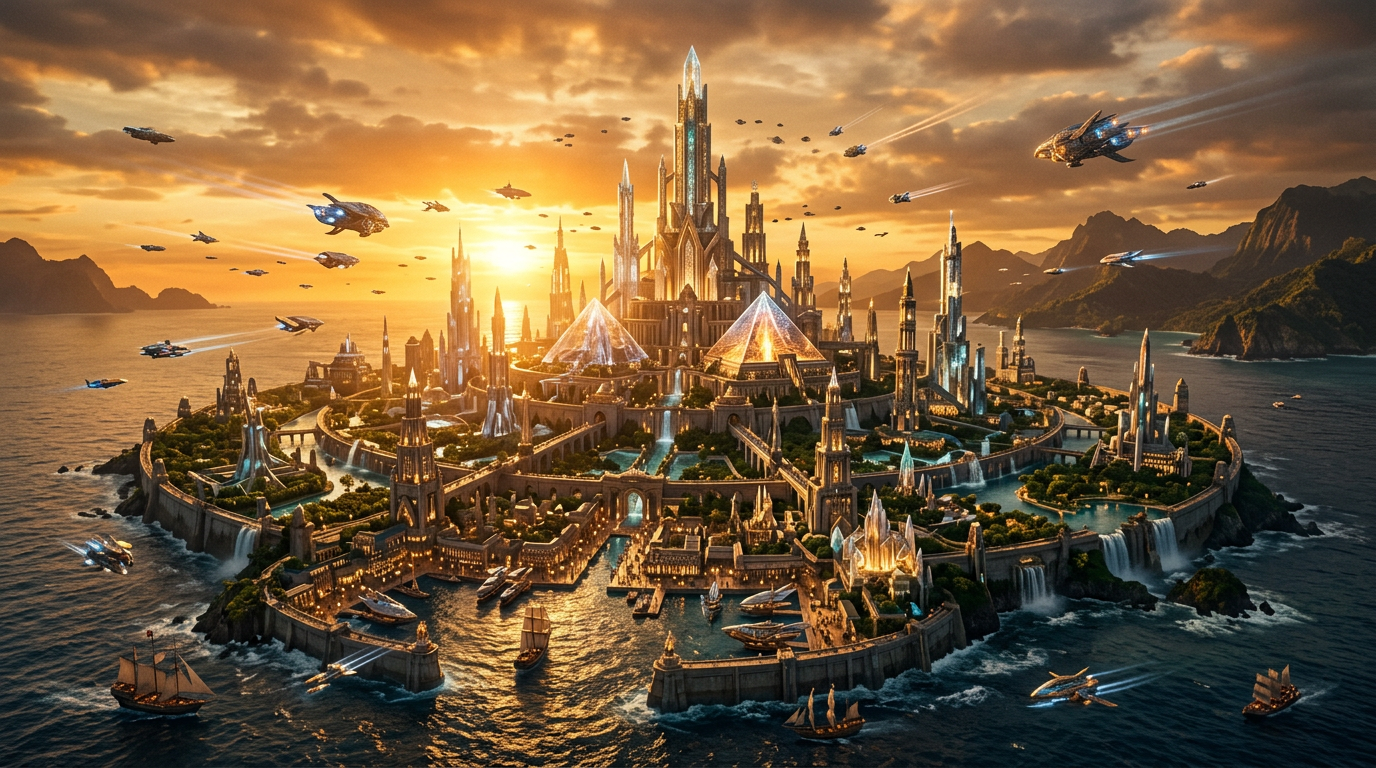
Atlantis
- Over 700 readings reference Atlantis; the most detailed single source in existence
- Cayce described Atlantis as a continent in the Atlantic Ocean; highly advanced technology
- The "Firestone" — a crystal energy device used for power, communication, and healing
- Atlantean flying craft ("things") powered by crystal energy
- The "Children of the Law of One" vs the "Sons of Belial" — spiritual civil war
- The three destructions: approximately 50,000 BCE, 28,000 BCE, and 10,500 BCE (final sinking)
- Survivors migrated to Egypt (established the mystery schools), the Yucatan (Maya connection), and the Pyrenees (Basque people)
- The Hall of Records: Cayce predicted a hidden chamber beneath the Sphinx's right paw containing Atlantean records
- Timaeus and Critias (360 BCE): Plato attributed the story to Egyptian priests speaking to the Athenian statesman Solon
- Atlantis described as an island "beyond the Pillars of Hercules" (Strait of Gibraltar), larger than Libya and Asia combined
- Advanced confederation of kings; powerful naval empire
- Became corrupted; the gods punished them; sank "in a single day and night" ~9,600 BCE
- Debate: literal history, legend, or philosophical allegory? Most mainstream scholars say allegory — but many details are suspiciously specific
- Richat Structure (Eye of the Sahara), Mauritania — concentric ring formations matching Plato's description; researchers Bright Insight and others have made the case extensively
- Atlantic Ridge — submarine mountain chain in the Atlantic where Atlantis might have sunk; some islands (Azores) are geological remnants
- Antarctic theory — Graham Hancock's Fingerprints of the Gods suggests Antarctica before the pole shift (c. 10,500 BCE)
- Graham Hancock's broader thesis: a global civilisation destroyed by cometary impact and floods ~10,800 BCE (Younger Dryas Impact hypothesis)
- Atlanteans lived in a world of mist and fog; consciousness was dreamy, imaginative, not yet fully rational
- They had mastery over life forces — could "tame" natural energies in ways we cannot
- Their civilisation was destroyed through spiritual imbalance and abuse of power
- The seeds of their wisdom were carried forward by initiate-priests into the post-Atlantean civilisations
Lemuria / Mu
- The Lost Continent of Mu (1926) — Churchward claimed to have read ancient Naacal tablets in a Tibetan monastery
- Mu placed in the Pacific Ocean; civilisation of 64 million people; destroyed ~12,000 years ago
- Described as the mother civilisation from which all others descended
- Highly controversial; no archaeological corroboration; but Pacific island traditions support some elements
- Blavatsky's The Secret Doctrine (1888): Lemurians were the "third root race" — semi-physical, androgynous, enormous in stature
- Lemuria placed in the Indian/Pacific Ocean region; preceded Atlantis
- Lemurian souls were more connected to the earth and nature; less individuated than Atlanteans
- The fall of Lemuria: misuse of sexual and creative forces
- Lemurian Seed Crystals: found in Brazil; said by channelers (especially those in the Kryon tradition) to be deliberately programmed crystals left by Lemurians for future activation
- Some Pacific island traditions (Hawaiian, Polynesian, Maori) preserve memories of a sunken homeland
- The connection between Lemurian spiritual wisdom and modern indigenous practices
Ancient Egypt
- Egyptian civilisation appeared with extraordinary suddenness; no clear developmental period
- Hieroglyphs appeared fully formed; no evolutionary stages from primitive to complex (unlike Sumerian cuneiform)
- The Dynastic Race problem: physical and cultural differences between early dynastic Egyptians and their predecessors
- Possible answer: survivors of a more advanced culture (Atlantis? A Sirian mission?) established Egyptian civilisation as a repository of ancient wisdom
- Geologist Robert Schoch (Boston University) demonstrated in the early 1990s that the Sphinx enclosure shows water erosion patterns consistent with heavy rainfall — which last occurred in the region ~7,000–10,000 BCE
- This would date the Sphinx to at least 7,000 BCE and possibly earlier — long before the conventional date of ~2,500 BCE (Khafre's reign)
- Mainstream Egyptology has largely rejected this; but the geological evidence has never been convincingly refuted
- John Anthony West championed Schoch's work; wrote Serpent in the Sky on the mystery of Egypt
- Edgar Cayce predicted: buried beneath the Sphinx's right paw lies a "Hall of Records" — Atlantean archives
- Geological surveys in the 1990s did find anomalous cavities beneath the Sphinx — but Egyptian authorities have restricted investigation
- The Giza Plateau as a whole may be a vast encoded message: alignments to Orion's belt (~10,500 BCE precession alignment), the Nile as the Milky Way
- Multiple channeled sources (including the Law of One and Robert Temple's The Sirius Mystery) connect ancient Egypt deeply to the Sirian civilisation
- The Dogon people of Mali possessed astronomical knowledge of Sirius B (a white dwarf invisible to the naked eye) before Western science confirmed its existence in 1970
- Robert Temple documented this in The Sirius Mystery (1976) — sparked enormous controversy
- Egyptian gods (Isis, Osiris, Thoth) are associated with Sirius across multiple traditions
- The possibility that Egyptian mystery schools preserved direct Sirian teachings
- Official position: royal tombs
- Alternative: no mummies, no grave goods have ever been found in the Great Pyramid
- Power plant theory (Christopher Dunn): the Great Pyramid as a precision acoustic and electromagnetic device
- Initiation chamber theory: the King's Chamber as a sarcophagal resonance chamber for consciousness expansion
- Harmonic resonance: the dimensions of the Great Pyramid encode pi, phi (golden ratio), and the dimensions of the Earth with extraordinary precision
Mesopotamia / Sumer
- Sumer: southern Iraq, ~3500 BCE; oldest written civilisation on record
- Cuneiform tablets: tens of thousands recovered; cover history, law, astronomy, medicine, commerce, mythology
- The suddenness of Sumerian civilisation's appearance remains unexplained by mainstream archaeology
- Extensive literature describing the "Anunnaki" — gods who came from above
- Enki (lord of wisdom, waters) and Enlil (lord of air, authority) as the two primary deities
- The Eridu Genesis: the Sumerian flood narrative predating the biblical account by over 1,000 years
- The Epic of Gilgamesh: contains a flood account nearly identical to Noah's story
- The Sumerians described "the me" — tablets of destiny containing the gifts of civilisation (writing, law, agriculture, metalworking, music) given to humans by the Anunnaki
- The sudden appearance of complex agriculture (~10,000 BCE in the Fertile Crescent) with no gradual development
- The Younger Dryas and the agricultural revolution: timing coincides with major cosmic event
- The Sumerian flood (Utnapishtim/Ziusudra), biblical Noah, Hindu Manu, Greek Deucalion, Mesoamerican Nata — all describe a global flood and single family of survivors
- Modern geology confirms: ~11,600 years ago (end of Younger Dryas), sea levels rose 120 metres globally as ice sheets melted
- The Black Sea flood hypothesis (Ryan & Pitman, 1997): the Mediterranean broke through to fill the Black Sea basin ~7,600 BCE
Mesoamerica
- The Maya Long Count calendar ended (or reset) on December 21, 2012 — the subject of enormous speculation
- The Maya possessed extraordinary astronomical knowledge: precise calculations of Venus cycles, eclipses, and galactic alignments
- The concept of World Ages: the Maya described multiple previous civilisations destroyed and renewed
- The Tzolkin calendar: 260-day sacred calendar aligned to human gestation and galactic cycles
- Quetzalcoatl: a bearded, pale-skinned deity who brought civilisation to the Aztecs; said to have come from across the sea
- His description does not match indigenous Mesoamerican physical characteristics
- Theories: a visitor from Atlantis? An ET? A traveller from across the Atlantic?
- His promise to return — which the Spanish conquistadors catastrophically exploited (Cortés as Quetzalcoatl)
- ~300 animal geoglyphs and geometric figures drawn in the Peruvian desert, visible only from altitude
- Made between ~100 BCE and 800 CE; purpose unknown
- Theories: astronomical calendar, ritual pathways, landing strips for ET craft, messages to the gods
- Maria Reiche (German mathematician) spent 50 years studying them; found astronomical alignments
- Erich von Däniken popularised the "landing strip" theory in Chariots of the Gods (1968)
- 17 colossal basalt heads found in southern Mexico; the oldest date to ~1500 BCE
- Features are distinctly African in appearance — broad nose, full lips, specific helmet design
- No conventional explanation for African presence in Mesoamerica 3,500 years ago
- Dr. Ivan Van Sertima's They Came Before Columbus (1976) argues for pre-Columbian African contact
- King Pacal of Palenque (603–683 CE); his tomb lid (discovered 1952) shows a figure inside a complex device
- Erich von Däniken interpreted it as a man operating a rocket — the "Palenque astronaut"
- Conventional interpretation: Pacal descending into the underworld (Xibalba), surrounded by serpent/tree symbolism
- The debate continues; the carving's complexity and detail are extraordinary
- Edgar Cayce (1877–1945) — American psychic; over 700 Atlantis-related readings; most detailed single source on Atlantean history
- Plato (428–348 BCE) — Greek philosopher; Timaeus and Critias contain the Atlantis account
- Rudolf Steiner (1861–1925) — Akashic readings in Cosmic Memory cover both Atlantis and Lemuria
- Robert Schoch — Boston University geologist; geological dating of the Sphinx to pre-10,000 BCE
- Graham Hancock — Author and researcher; Fingerprints of the Gods, Magicians of the Gods, America Before; argues for a global civilisation destroyed ~10,800 BCE
- John Anthony West (1932–2018) — Egyptologist and writer; championed Schoch's Sphinx dating; Serpent in the Sky
- Robert Temple — Author of The Sirius Mystery (1976); documented the Dogon-Sirius connection
- James Churchward (1851–1936) — Author of the Mu/Lemuria books; claims based on claimed access to ancient tablets
- Zecharia Sitchin — Sumerian translations and Anunnaki hypothesis (see also Section 2)
- Erich von Däniken — Author of Chariots of the Gods (1968); popularised the ancient astronaut hypothesis globally
- Christopher Dunn — Engineer; The Giza Power Plant — argues the Great Pyramid was a precision machine
- Search: "Graham Hancock Fingerprints of Gods lecture" — comprehensive ancient civilisations overview
- Search: "Robert Schoch Sphinx water erosion evidence" — geological dating of Egypt's Sphinx
- Search: "Edgar Cayce Atlantis readings complete" — the primary channeled Atlantis source
- Search: "Richat Structure Atlantis Eye of Sahara" — physical location hypothesis
- Search: "Sirius Mystery Robert Temple Dogon" — Egyptian-Sirian connection
- Search: "Nazca Lines mystery documentary" — geoglyph purpose and creation
- Search: "Matias De Stefano Atlantis Lemuria Akashic" — channeled account
- Search: "Maya calendar decoded galactic alignment" — Mesoamerican cosmology
- Channel: UnchartedX — independent researcher Ben Van Kerkwyk; rigorous evidence-based examination of anomalous ancient sites
- Channel: Universe Inside You — well-produced ancient history and spiritual content
- Fingerprints of the Gods — Graham Hancock | https://www.amazon.co.uk/dp/0712670327
- Magicians of the Gods — Graham Hancock | https://www.amazon.co.uk/dp/1444779044
- The Sirius Mystery — Robert Temple | https://www.amazon.co.uk/dp/0099258919
- Serpent in the Sky — John Anthony West | https://www.amazon.co.uk/dp/0835606910
- Cosmic Memory: Atlantis and Lemuria — Rudolf Steiner | https://www.amazon.co.uk/dp/0893450529
- The Giza Power Plant — Christopher Dunn | https://www.amazon.co.uk/dp/1879181770
- Chariots of the Gods — Erich von Däniken | https://www.amazon.co.uk/dp/0552088706
- They Came Before Columbus — Ivan Van Sertima | https://www.amazon.co.uk/dp/0812968174
"My readings indicate that there was indeed a civilisation in Atlantis thousands of years ago... they had aircraft, submarines, and power derived from a great crystal that could be used for both creation and destruction."— Edgar Cayce (reading paraphrase)
"In this island of Atlantis there was a great and wonderful empire which had rule over the whole island and several others, and over parts of the continent... But afterwards there occurred violent earthquakes and floods, and in a single day and night of misfortune, the island of Atlantis disappeared into the depths of the sea."— Plato, *Timaeus*
"The geological evidence at the Sphinx site is unambiguous. The weathering patterns can only be explained by prolonged rainfall — rainfall that has not occurred in this region for at least 7,000 to 10,000 years."— Robert Schoch
"Göbekli Tepe changes everything. Here is a site 12,000 years old that required a large, organised, sophisticated society to build. Everything we thought we knew about the development of civilisation needs revision."— Klaus Schmidt, excavator of Göbekli Tepe
- → Section 2: Human Creation — Anunnaki role in seeding civilisation
- → Section 3: Galactic History — the cosmic context for Atlantis and Lemuria
- → Section 5: ET Races — the Sirian and Pleiadian roles in ancient cultures
- → Section 8: Galactic Wars — Maldek's destruction and its connection to Earth's reset
- Aerial photograph of the Richat Structure (Eye of the Sahara), Mauritania
- The Great Sphinx of Giza — close-up of water erosion striations
- Edgar Cayce portrait and an image of the Association for Research and Enlightenment (A.R.E.)
- Plato's description of Atlantis: map reconstruction based on Critias
- Sumerian cuneiform tablets — close-up photography
- Nazca Lines aerial view — the hummingbird or spider geoglyphs
- The lid of Pacal's tomb — Palenque, Mexico (full high-resolution image)
- Olmec colossal head — frontal photograph showing facial features
- Graham Hancock standing at megalithic sites (Göbekli Tepe, Sacsayhuamán)


📺 WATCH — PAST CIVILISATIONS
Graham Hancock — Ancient Civilisations & Hidden History
Randall Carlson — Cosmic Catastrophe & the Lost Civilisation
Robert Schoch — The Sphinx & Evidence of Advanced Prehistory
Graham Hancock — Lost Civilization of the Ice Age (Lex Fridman)
Alex Collier 1994 — Galactic History & Ancient Earth
Law of One — Ra Material: Atlantis & Ancient Civilisations
Jacques Vallee — Ancient Contact & Civilisation Origins
Diana Pasulka — UAP, Technology & Ancient Civilisations
Steven Greer Disclosure Project 2001 — Ancient Contact Evidence
Edgar Cayce on Atlantis — Full Audiobook
Explore Each Civilisation
Plato's accounts, Edgar Cayce's 700+ readings, crystal power systems, and the evidence for catastrophic destruction.
James Churchward's research, Theosophical accounts, connections to Pacific island cultures and Aboriginal traditions.
Pyramid as power plant, Sphinx water erosion, Hall of Records, and the Sirian connection.
The Anunnaki tablets, sudden emergence of civilisation, the Great Flood, and Zecharia Sitchin's translations.
Maya astronomical precision, Quetzalcoatl as ET, Nazca Lines, Pacal's tomb, and Puma Punku.